
The New Financial Freedom Framework
A More Grounded Approach to Financial Independence

Financial freedom is usually taught as a math problem. Earn more. Spend less. Invest consistently. Wait. The formulas work — on paper. But after rebuilding from financial fragility, I’ve realized the real issue isn’t knowing the rules. It’s understanding the sequence.
In 2026, the problem for many people in their 20s and 30s isn’t that they don’t know how to invest or that they detest their jobs. The problem is that their lives are fragile, always one degree away from catastrophe. One job loss, one burnout spiral, one market downturn, and everything feels unstable again.
The numbers still matter. But the order of operations matters more.
What I’ve come to believe is that financial independence isn’t built in a straight line from saving to investing to retiring. It’s built in layers. Each layer reduces fragility and increases control.
Stability comes first.
Then margin.
Then leverage.
Only after that does optionality appear.
Most advice skips ahead. It assumes stability. It assumes resilience. It assumes you can tolerate risk without consequence. But if the foundation is fragile, every decision feels heavier than it should.
Before wealth, there must be stability. Before speed, there must be margin.
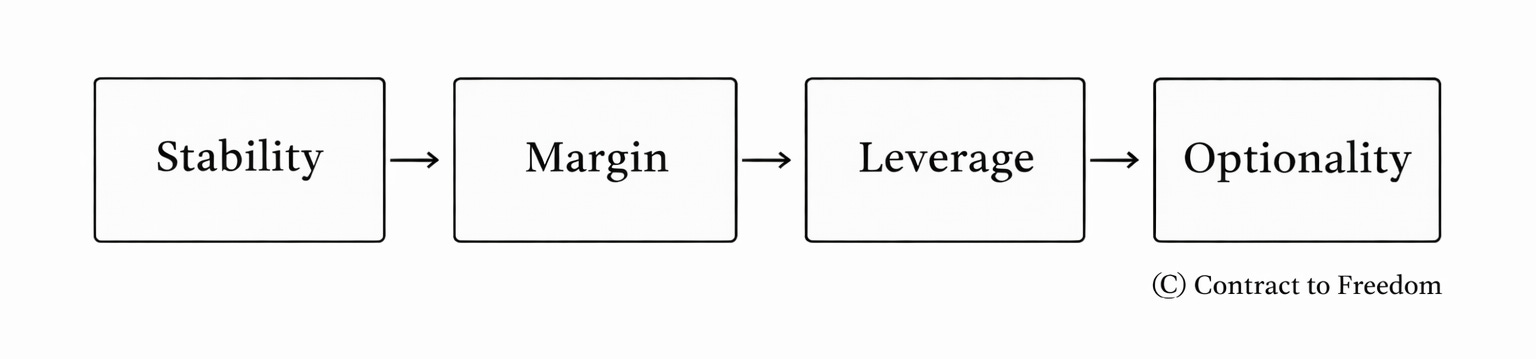
Phase I: Stabilize
Goal: Stop bleeding; remove fragility.
Track 90 days of real numbers
Preferably, to save time, do a look-back at the previous three months. Take several hours to go through bank statements and credit card statements to see how much you spent over those three months as well as how much you earned. Now determine your annual expenses (add your three months of expenses together, then multiply that sum by four). You’ll need this number in Phase II.
i.e. January expenses = $4,000; February expenses = $3,500; March expenses = $5,000. Sum = $4,000 + $3,500 + $5,000 = $12,500. Annual expenses = $12,500 x 4 = $50,000
Cut large, fixed expenses
The most powerful expenses to cut aren’t your coffees and sandwiches. The biggest impact you can make on your overall expenses are in your largest expenses: housing, transportation, and food. Find roommates. Move closer to your job. Eat out less and buy healthy, whole foods.
Save a $1,000-3,000 starter emergency fund
Now that you have decreased expenses, you can start to truly stabilize. The best way to prepare for emergencies is to have some spare cash laying in your bank account; small emergencies will be a much more manageable event if you have enough money to cover them.
Eliminate high-interest debt (>6%)
The final step of stabilization involves destroying all high-interest debt. I define high-interest debt as debt with an interest rate higher than 6%. The debt avalanche is the most mathematically inclined way to get rid of debt. You use your disposable income (from your frugal lifestyle) to pay off the debt with the highest interest rate. After it’s paid off, you move on to the next, until you have no more high-interest debt.
Phase II: Build Margin
Goal: Create breathing room.
Expand emergency fund to 12 months of expenses
Now that you’ve paid off all high-interest debt, you get to use the number you calculated in the first phase. At this point, your savings rate should be around 50% (that is, you should be saving 50% of your income). With that high savings rate, save a year’s worth of expenses. This will take considerable time unless you have a huge delta between income and expenses (i.e. extremely frugal doctor).
Capture employer match
During this phase, make sure you start taking advantage of your company’s 401(k) match. If they offer a match, make sure you meet it to get the “free” money.
Resist lifestyle inflation
This is hard. With your newfound disposable income and growing bank account, you might think it’s time to buy a nice car, move to a luxury apartment, or buy guacamole at Chipotle. Now’s not the time. It’s coming. Keep your frugal lifestyle.
Phase III: Create Leverage
Goal: Widen the gap between income and obligations.
Increase income aggressively:
Negotiate with your employer to gain a considerable raise. This requires serious skill and dependability.
Change employers/careers if you aren’t valued. You have 12 months of expenses saved, so even if it doesn’t work out, you’re safe from hard times for a year.
Add high-ROI certifications, especially if your current employer will pay for the certifications.
Use geographic arbitrage to earn a high income in a high cost-of-living area while living in a lower cost-of-living location if you have the opportunity for work-from-home or hybrid jobs.
Work overtime strategically if you’re an hourly employee.
Phase IV: Harness Optionality
Goal: With stability, margin, and leverage, enjoy lifestyle optimization.
Choose your brand of FI:
Traditional investing - maximizing 401(k), IRA, HSA contributions and the like
Skill acquisition - learning valuable skills that are in low supply and high demand to further increase your earning power
Asset acquisition - purchasing cash-flowing rental properties and purchasing or creating businesses
Hybrid approach
I’m still walking this path myself. But the further I go, the clearer it becomes: the goal isn’t to escape work or retire as fast as possible. It’s to build a life that doesn’t collapse under pressure. Stability first. Margin next. Leverage with intention. Optionality earned — not assumed.